AI Systems
liveCubetek 2.0
The lab pointed at itself: an AI-agent system that finds, qualifies, and follows up on leads, answers voice calls, and reports daily — with a human approving every send.
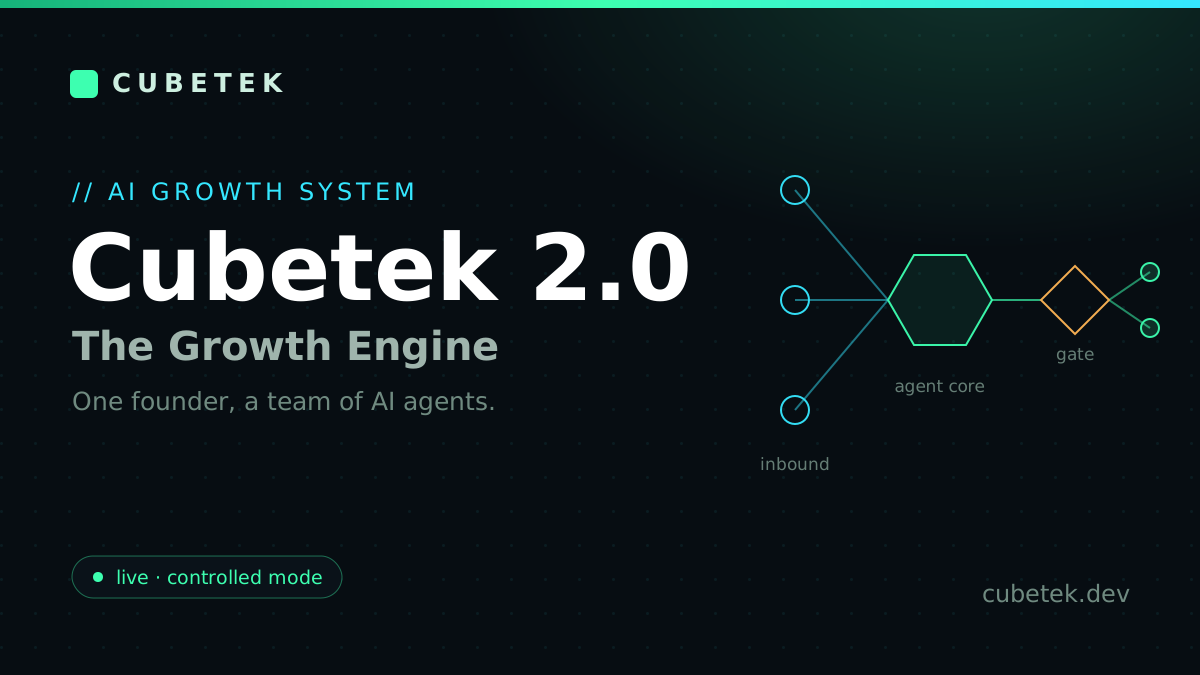
Cubetek 2.0 is the lab pointed at itself — an internal AI system that runs Cubetek's own growth. It finds leads, checks whether they fit, researches them, drafts the outreach, answers inbound calls, and reports to the founder every morning. One senior engineer, amplified by a team of AI agents, doing the work of a growth department. ⭐ The golden rule, baked into the architecture: the system never contacts a customer or publishes anything without approval. It does the work; the founder presses yes or no.
The problem
A one-person lab has a hard ceiling. The same person who builds the software also has to find the work, qualify it, follow up, answer the phone, and keep the pipeline honest. Those hours don't scale, and good leads slip through the cracks.
Cubetek 2.0 removes the repetitive labour — the searching, sorting, drafting, and summarizing — without giving up a single decision.
How it works, in one picture
Every inbound channel — a website form, a direct message, a phone call, an email — lands in one place. An AI agent normalizes it, records it, scores it, and decides what to do next. Anything that leaves the building waits for the founder's approval.
The stack — boring on purpose
Nothing here is new software for its own sake. The engine is assembled from a fixed, reliable set of building blocks, each doing one job well:
- An AI agent core — orchestration, planning, judgement, and controlled execution.
- A business suite — the system of record for mail, calendar, bookings, and finance.
- A CRM and call log — every lead and interaction, deduplicated.
- An AI voice line — answers the phone and hands back a summary.
- A messaging channel — where the founder approves work and reads the daily digest.
What the AI does — and what it's never allowed to do
The single most important design decision in Cubetek 2.0 is the line between judgement and math.
The AI is used only for judgement: reading a free-text brief and pulling out the name, company, and intent; drafting content and replies; summarizing a phone call; classifying what a message is about.
Everything that has to be exactly right is plain, deterministic code: capturing and de-duplicating leads, scoring and tiering them, the mechanics of sending and publishing, and every number in a report. The AI never touches money or state math.
| Step | Deterministic | AI (judgement) |
|---|---|---|
| Parse an inbound event, dedup, upsert | ✅ | |
| Extract name / company / intent from free text | ✅ | |
| Compute lead score and tier | ✅ | |
| Draft content, replies, call summaries | ✅ | |
| Send, publish, book | ✅ (gated by approval) | |
| Aggregate the weekly metrics | ✅ |
Organized like a tiny company
The system is structured the way a small team is. A senior-engineer lead takes the founder's intent and delegates to specialized AI roles:
- Content — drafts posts, threads, and the publishing schedule.
- Customer service — triages inbound messages, answers routine questions, and routes anything real.
Each role can prepare work. None of them can send it. That is the approval gate.
Inbound voice
When someone calls the lab, an AI receptionist handles the conversation, and the founder gets a clean summary — who called, what they wanted, and whether it's worth a callback. Verified end to end on a real call.
Human-in-the-loop, by design
Every outbound action passes through the same gate: draft → the founder approves → execute and log. Deny it or ignore it, and it aborts. The founder's daily routine is about ten minutes — read the digest, clear the top three, done.
Built to run unattended
Reliability is not an afterthought:
- Every workflow writes an append-only run log.
- Transient failures retry with backoff, then dead-letter to a founder alert.
- The engine backs itself up daily and ships with a health check and a regression gate.
- It runs as auto-restarting services, so it survives a reboot.
Where it stands
Cubetek 2.0 is live in controlled mode — built end to end, tested, and backed up. The voice pipeline is proven on real calls. Every external action still waits for a human yes. The next step is volume: pointing the prospecting at the right targets and letting the loop run.